
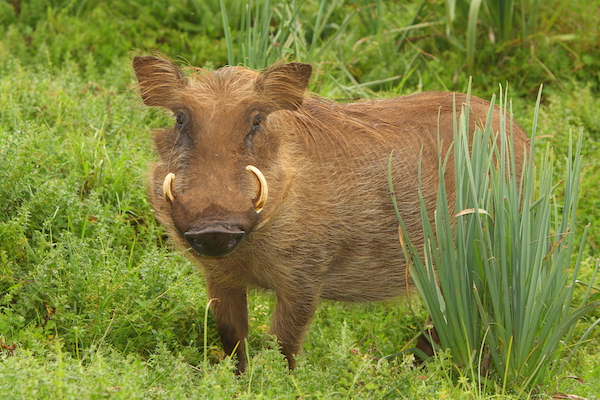
WARTHOGS
The common warthog is the only pig species that has adapted to grazing and savanna habitats.[7] Its diet is omnivorous, composed of grasses, roots, berries and other fruits, bark, fungi, insects, eggs and carrion.[8] The diet is seasonably variable, depending on availability of different food items. During the wet seasons, warthogs graze[7] on short perennial grasses.[9] During the dry seasons, they subsist on bulbs, rhizomes, and nutritious roots.[7][9]
Warthogs are powerful diggers, using both their snouts and feet. When feeding, they often bend their front feet backwards and move around on the wrists.[10] Calloused pads that protect the wrists during such movement form quite early in the development of the fetus. Although they can dig their own burrows, they commonly occupy abandoned burrows of aardvarks[9] and other animals. The common warthog commonly reverses into burrows, with its head facing the opening and ready to burst out if necessary. Common warthogs will wallow in mud to cope with high temperatures and huddle together to cope with low temperatures.[11]
Although capable of fighting (males aggressively fight each other during mating season), the common warthog's primary defense is to flee by means of fast sprinting. When threatened, Warthogs can run speeds of up to 48 km/h (30 mph), will run with their tails sticking up and will enter their dens rear first with tusks facing out.[12] The common warthog's main predators are humans, lions, leopards, cheetahs, crocodiles, wild dogs and hyenas. Birds of prey such as Verreaux's eagle owls and martial eagles sometimes prey on piglets.[13][14] However, if a female common warthog has any piglets, she will defend them very aggressively. On occasion, common warthogs have been observed charging and even wounding large predators. Common warthogs have also been observed allowing banded mongooses and vervet monkeys to groom them to remove ticks.[15]
WHERE WILL YOU FIND THEM
Home, sweet aardvark hole: Warthogs live in Africa's southern Sudan and southwestern Ethiopia, in savanna woodland and grasslands—and they are not picky about their homes. Instead of digging their own burrows, they find abandoned aardvark holes or natural burrows for homes.