
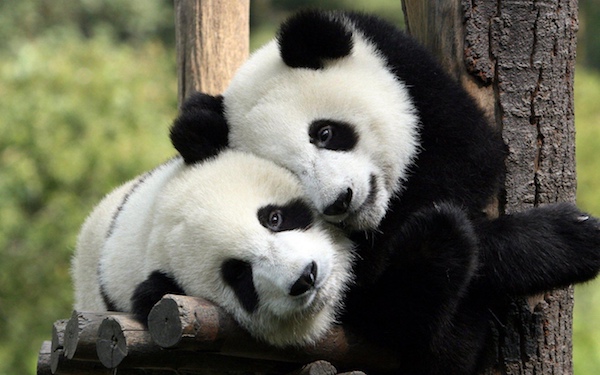
PANDAS
is a bear[6] native to South Central China.[1] It is characterised by its bold black-and-white coat and rotund body. The name "giant panda" is sometimes used to distinguish it from the red panda, a neighboring musteloid. Though it belongs to the order Carnivora, the giant panda is a folivore, with bamboo shoots and leaves making up more than 99% of its diet.[7] Giant pandas in the wild will occasionally eat other
As a result of farming, deforestation, and other development, the giant panda has been driven out of the lowland areas where it once lived, and it is a conservation-reliant vulnerable species.[11][12] A 2007 report showed 239 pandas living in captivity inside China and another 27 outside the country.[13] As of December 2014, 49 giant pandas lived in captivity outside China, living in 18 zoos in 13 different countries.[14] Wild population estimates vary; one estimate shows that there are about 1,590 individuals living in the wild,[13] while a 2006 study via DNA analysis estimated that this figure could be as high as 2,000 to 3,000.[15] Some reports also show that the number of giant pandas in the wild is on the rise.[16] In March 2015, conservation news site Mongabay stated that the wild giant panda population had increased by 268, or 16.8%, to 1,864.[17] In 2016, the IUCN reclassified the species from "endangered" to "vulnerable", [12] affirming decade-long efforts to save the panda.
The word panda was borrowed into English from French, but no conclusive explanation of the origin of the French word panda has been found. [23] The closest candidate is the Nepali word ponya, possibly referring to the adapted wrist bone of the red panda, which is native to Nepal. The Western world originally applied this name to the red panda.
WHERE WILL YOU FIND THEM
Pandas live mainly in temperate forests high in the mountains of southwest China, where they subsist almost entirely on bamboo. They must eat around 26 to 84 pounds of it every day, depending on what part of the bamboo they are eating