
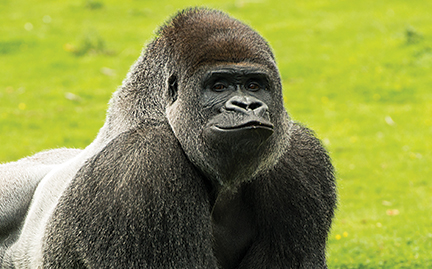
GORILLA
are ground-dwelling, predominantly herbivorous great apes that inhabit the tropical forests of central Sub-Saharan Africa. The genus Gorilla is divided into two species: the eastern gorillas and the western gorillas, and either four or five subspecies. They are the largest living primates. The DNA of gorillas is highly similar to that of humans, from 95 to 99% depending on what is included, and they are the next closest living relatives to humans after chimpanzees and bonobos.
Gorillas are the largest non-human primates, reaching heights between 1.25-1.8 metres, weights between 100–270 kg, and arm spans up to 2.6 metres, depending on species and sex. They tend to live in troops, with the leader being called a silverback. The Eastern gorilla is distinguished from the Western by darker fur colour and some other minor morphological differences. Gorillas tend to live 35–40 years in the wild.
Gorillas' natural habitats cover tropical or subtropical forest in Sub-Saharan Africa. Although their range covers a small percentage of Sub-Saharan Africa, gorillas cover a wide range of elevations. The mountain gorilla inhabits the Albertine Rift montane cloud forests of the Virunga Volcanoes, ranging in altitude from 2,200 to 4,300 metres (7,200 to 14,100 ft). Lowland gorillas live in dense forests and lowland swamps and marshes as low as sea level, with western lowland gorillas living in Central West African countries and eastern lowland gorillas living in the Democratic Republic of the Congo near its border with Rwanda.
WHERE WILL YOU FIND THEM
Habitat. Mountain gorillas live in Rwanda, Uganda and the Democratic Republic of the Congo, on green, volcanic mountains. Lowland gorillas live in the forests of central and western Africa in Equatorial Guinea, Angola, Cameroon, the Central African Republic, Congo, Gabon and the Democratic Republic of the Congo