
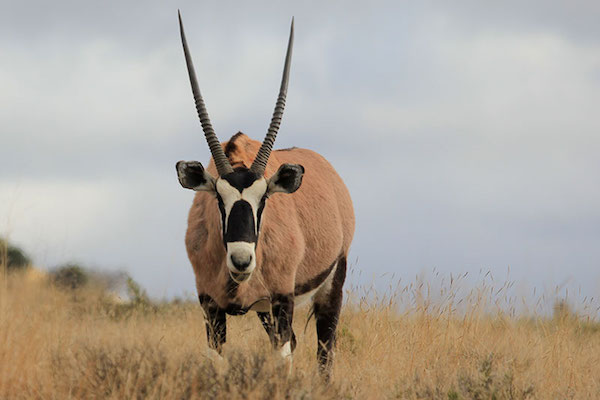
GEMSBOK
Gemsbok are light brownish-grey to tan in colour, with lighter patches toward the bottom rear of the rump.Their tails are long and black in colour . A blackish stripe extends from the chin down the lower edge of the neck, through the juncture of the shoulder and leg along the lower flank of each side to the blackish section of the rear leg. They have muscular necks and shoulders, and their legs have white 'socks' with a black patch on the front of both the front legs, and both genders have long, straight horns..
Gemsbok are the largest species in the genus Oryx. They stand about 1.2 m (3.9 ft) at the shoulder. [7][8] The body length can vary from 190 to 240 cm (75 to 94 in) and the tail measures 45 to 90 cm (18 to 35 in). 9] Male gemsbok can weigh between 180 and 240 kg (400 and 530 lb), while females weigh 100–210 kg (220–460 lb.
Gemsbok are widely hunted for their spectacular horns that average 85 cm (33 in) in length. From a distance, the only outward difference between males and females is their horns, and many hunters mistake females for males each year. In males horns tend to be thicker with larger bases. Females have slightly longer, thinner horns. Female gemsbok use their horns to defend themselves and their offspring from predators, while males primarily use their horns to defend their territories from other males.[10].
WHERE WILL YOU FIND THEM
the gemsbok, or gemsbuck, can be found on the grasslands or savannas and on flat or hilly country in the Kalahari Desert in Southern Africa. They are well adapted to the conditions of their hot, arid habitats..